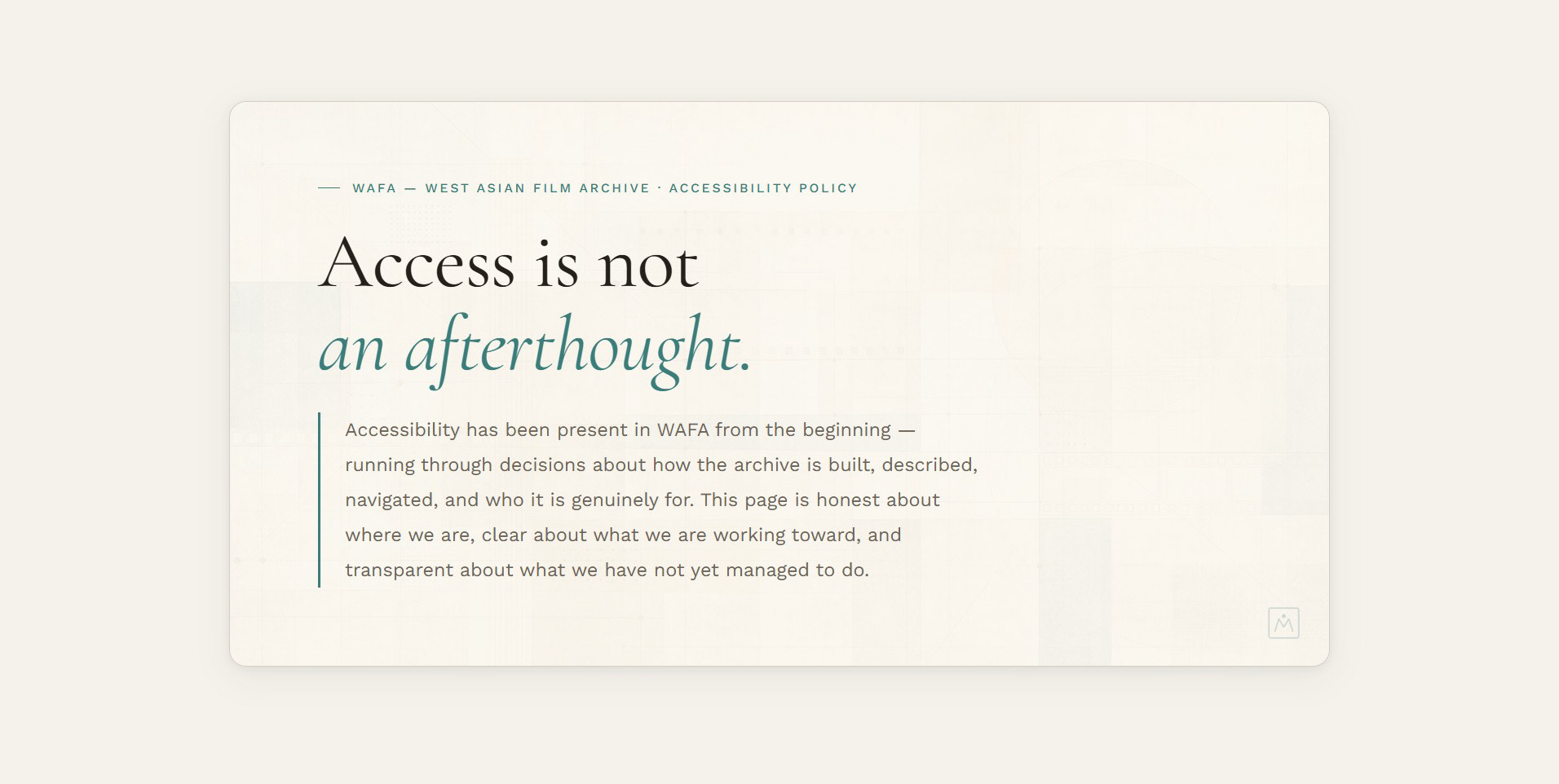
Accessibility is not a feature WAFA added at the end, once everything else was finished, as a kind of conscience tick-box. It is a question that has been present from the beginning, running through decisions about how the archive is built, how it is described, how it can be navigated, and who it is genuinely for.
This page exists to be honest about where we are, clear about what we are working toward, and transparent about what we have not yet managed to do. Accessibility policies that describe only the ideal state of a project are aspirational documents dressed up as factual ones. WAFA would rather tell you what is actually true, acknowledge what is incomplete, and explain the thinking behind both.
The short version: WAFA is committed to being as accessible as possible across as many dimensions of that word as we can meaningfully address. The longer version follows.
Accessibility means different things in different contexts, and WAFA uses the term in a broader sense than its most familiar technical application.
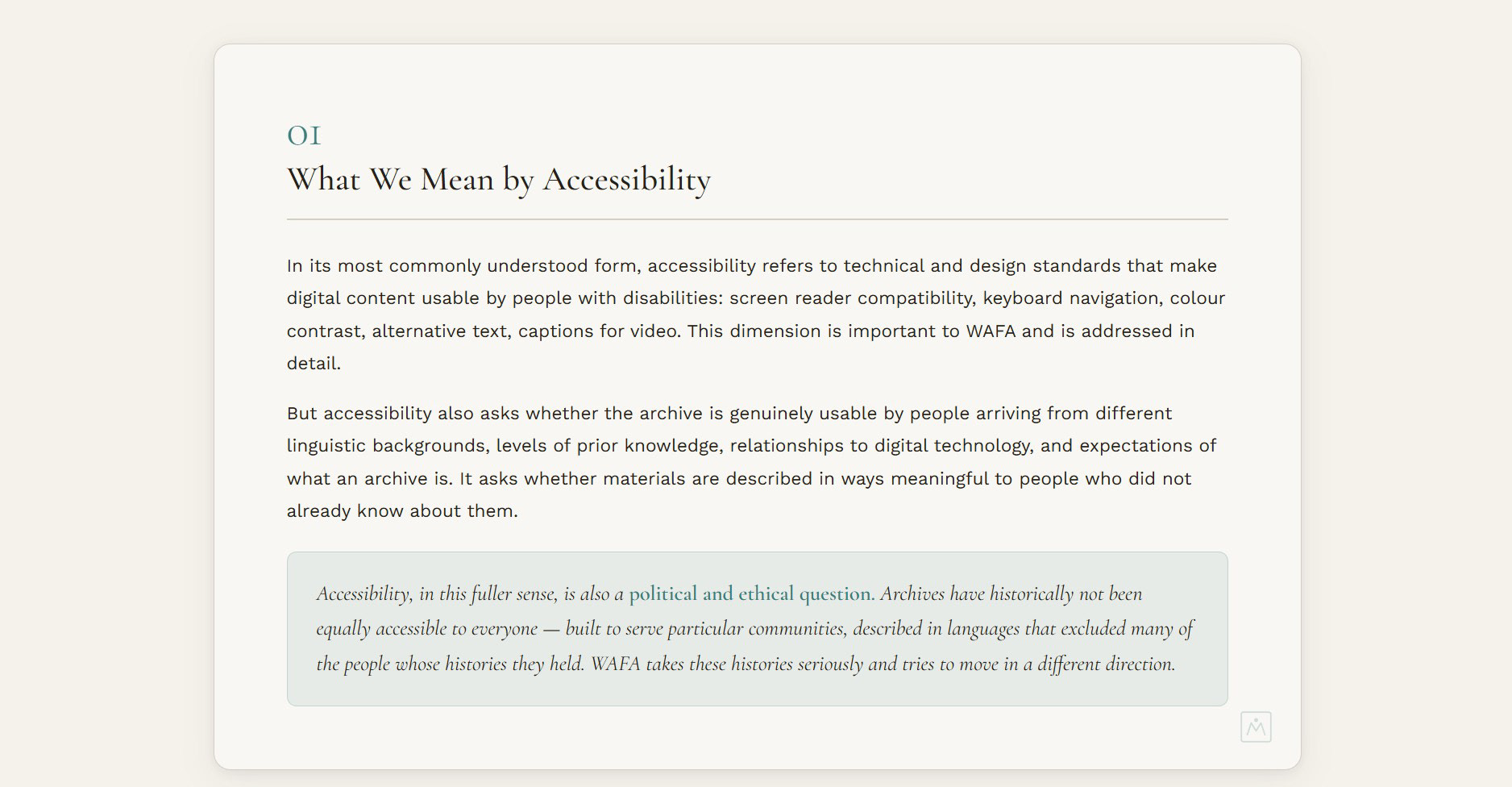
In its most commonly understood form, accessibility refers to the technical and design standards that make digital content usable by people with disabilities: screen reader compatibility, keyboard navigation, colour contrast ratios, alternative text for images, captions for video, and the various other provisions that ensure a website or application does not exclude people based on how they interact with technology. This dimension of accessibility is important to WAFA, and it is addressed in detail below.
But accessibility also means something broader. It means asking whether the archive is genuinely usable by people who come to it from different linguistic backgrounds, different levels of prior knowledge about the region or its cinema, different relationships to digital technology, and different expectations of what an archive is and how it works. It means asking whether the materials within the archive are described in ways that are meaningful to people who did not already know about them. It means asking whether the interactive design of the archive the Twine-based navigation, the sound elements, the layered structure places unnecessary barriers between users and the materials they are trying to reach.
Accessibility, in this fuller sense, is also a political and ethical question. Archives have historically not been equally accessible to everyone. They have been built to serve particular communities, located in places that require significant resources to reach, described in languages that exclude many of the people whose histories they hold, and governed by access policies that prioritise institutional affiliations over genuine public engagement. WAFA takes these histories seriously and tries to make decisions that move in a different direction, while being honest about the constraints it operates under.
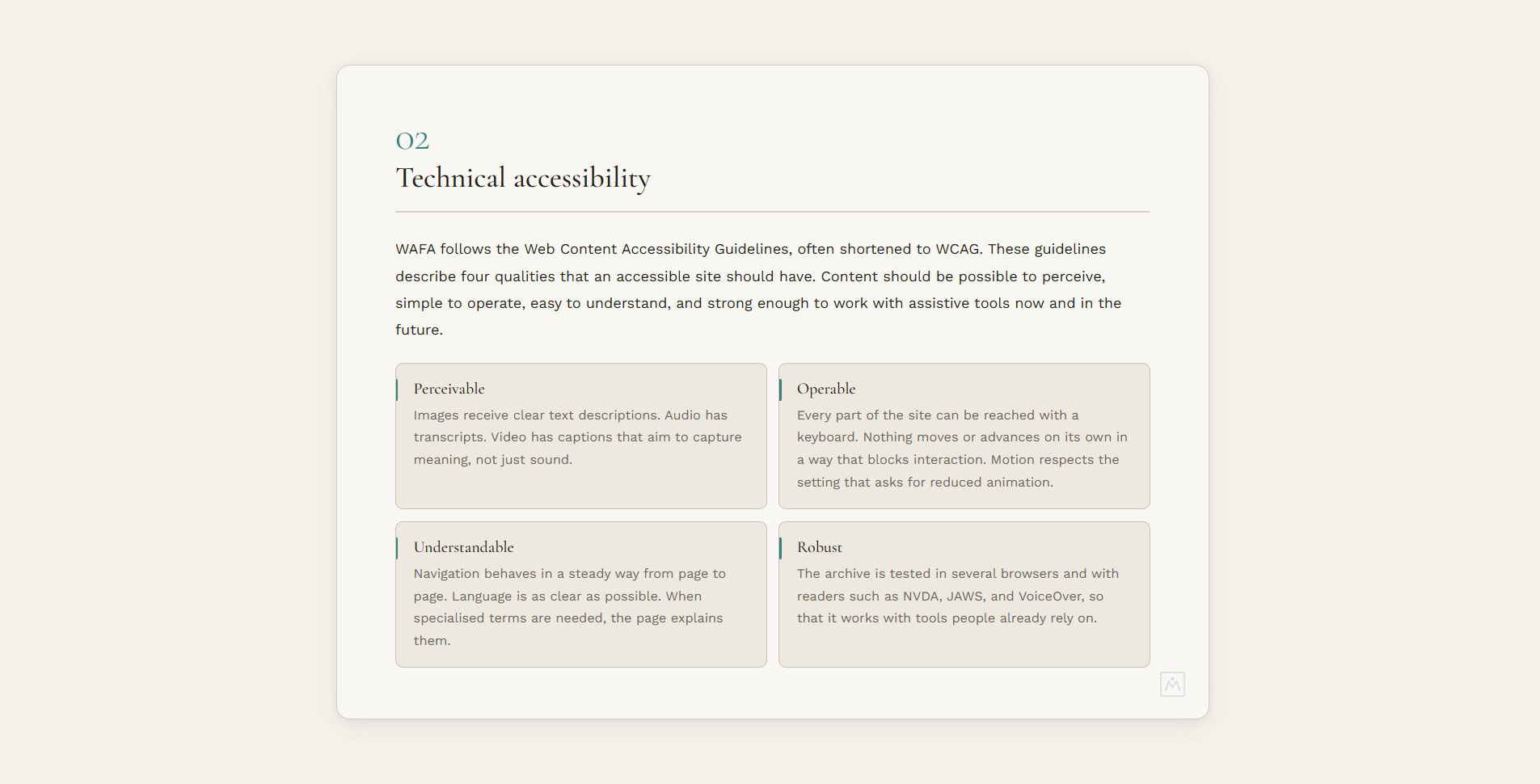
The digital infrastructure of WAFA is designed with reference to the Web Content Accessibility Guidelines (WCAG), a set of internationally recognised standards developed to make web content usable by people with a wide range of disabilities. These guidelines are organised around four core principles: that web content should be perceivable, operable, understandable, and robust. WAFA uses these as working criteria rather than a checklist to be completed and filed away.
Perceivable content means that information is available to users regardless of how they perceive it. For WAFA, this involves providing text alternatives for non-text content wherever possible alternative text descriptions for images, transcripts for audio materials, and captions for video content. Writing useful alternative text for archival images is not always straightforward. A still from a film carries information about composition, lighting, expression, and context that a brief description cannot fully convey, and WAFA approaches this as a genuine descriptive challenge rather than a bureaucratic obligation. Descriptions are written to be genuinely informative, not merely compliant, and they are updated when feedback indicates they are insufficient.
Audio materials present their own challenges. The sound archive within WAFA includes oral histories, ambient recordings, and experimental compositions, and the principle of providing transcripts is complicated when the material is not primarily verbal, or when it is in a language that requires not only transcription but translation. WAFA is working toward transcription and translation for all oral and spoken materials, but this is a slow process, and the current state of the collection reflects where that work currently stands.
Video and audiovisual content is similarly complex. Film clips held within the archive vary considerably in terms of the availability of original captions and subtitles. Where original caption files exist, they are included. Where they do not, WAFA creates them but the scale of the collection means that this work is ongoing rather than complete. Priority is given to materials that are most frequently accessed and to those where the lack of captions represents the most significant barrier.
Operable content means that users can navigate and interact with the archive regardless of the input device or method they use. WAFA's interactive layer, built in Twine, is designed to be fully navigable by keyboard, without requiring mouse or touchscreen interaction. All interactive elements links, choices, navigational controls are reachable via keyboard and are clearly labelled so that their function is unambiguous to users navigating with assistive technologies. The focus order through the interface follows a logical sequence that corresponds to the visual structure of the page, so that keyboard navigation does not produce a confusing or arbitrary experience.
Timing is an important consideration in interactive environments, and WAFA is attentive to the fact that some users need more time to read, process, and respond to content than others. There are no timed elements within the interactive layer that advance automatically or expire. Users move through the archive at their own pace, and the interface does not impose any pressure to do so quickly.
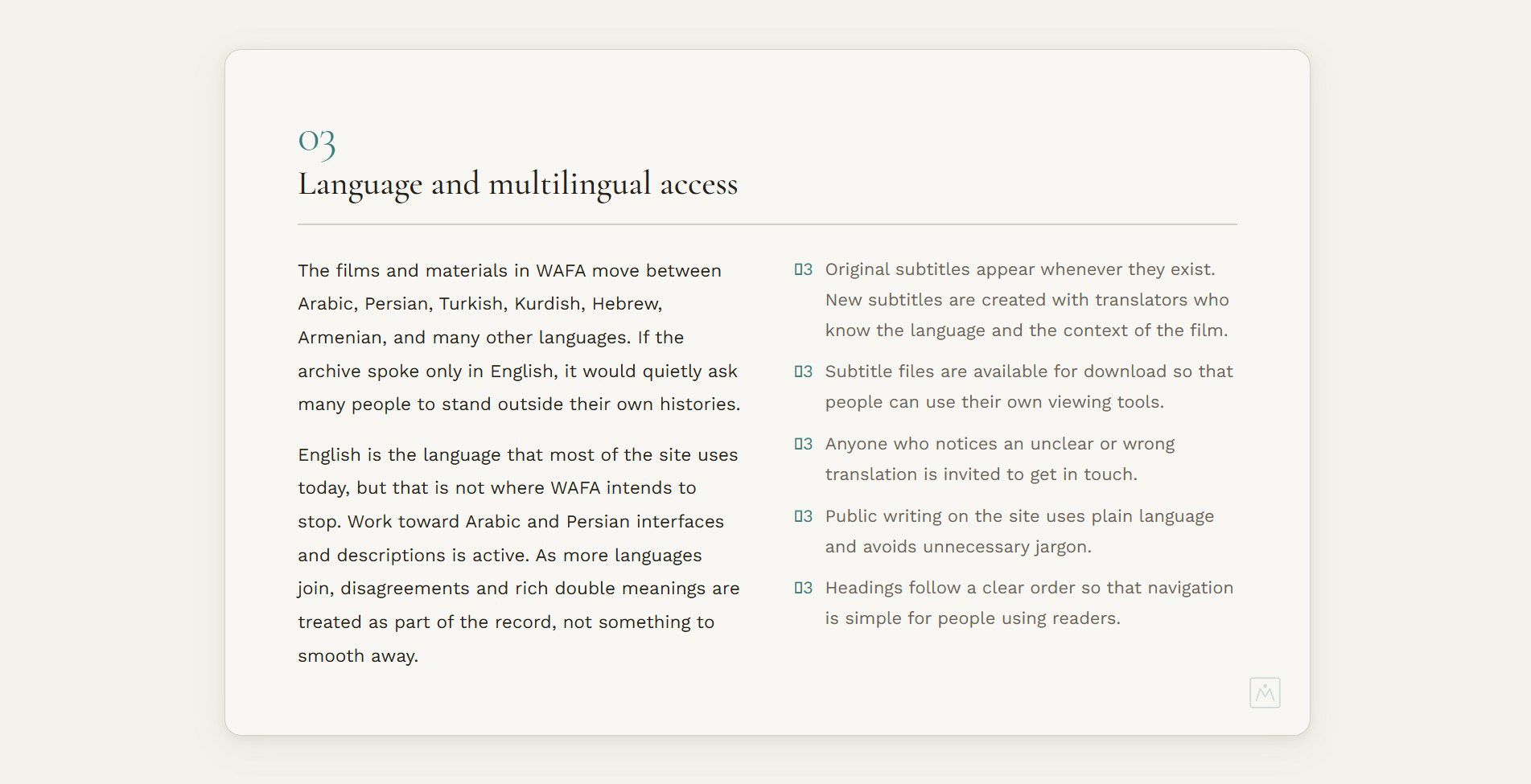
Language and Multilingual Access
Language accessibility is among the most complex and most important dimensions of what WAFA is trying to do.
The archive engages with film cultures that operate across Arabic, Persian, Turkish, Kurdish, Hebrew, Armenian, and numerous other languages. Many of the users most directly connected to these film cultures may not have English as a primary language. An archive that operates exclusively in English is, in a quiet but significant way, building a barrier between itself and many of the people whose histories it claims to be serving.
WAFA is developing toward multilingual access across its interface, its descriptive texts, and its interactive content. This is a substantial undertaking, and the current state of the archive reflects where that development currently stands rather than where it is headed. English is currently the primary language of the interface, but work is underway to extend this, beginning with Arabic and Persian given the breadth of materials those languages connect to within the collection.
Translation within WAFA is not treated as a neutral technical operation. As discussed elsewhere on this site, the act of translating between languages involves interpretive decisions, and meaning does not transfer perfectly across linguistic boundaries. Where translations are uncertain, partial, or contested, this is noted within the archive rather than smoothed over. Users who encounter a translation that they believe to be misleading, inaccurate, or culturally insensitive are encouraged to tell us, via the contact details at the bottom of this page.
Subtitling for film content follows the same principles. Original subtitles are included where they exist; where they do not, WAFA creates them, in consultation with translators who have relevant linguistic and cultural knowledge. Subtitle files are formatted to be compatible with standard assistive playback tools and are made available for download as well as display, so that users who need to access them in specific formats for their own assistive technologies can do so.
Plain language is a commitment that runs across all public-facing content. This policy is itself an attempt to demonstrate what that means in practice: complex ideas are explained in full sentences rather than abbreviated or assumed; terminology is defined when it is introduced; and the structure of each page is designed to make information easy to locate without requiring users to read everything in sequence.
Readability standards inform the writing of all descriptive and contextual materials within the archive. Sentences are kept to manageable lengths. Paragraphs are not overloaded. Heading structures are used consistently to allow users to navigate content efficiently, including those using screen readers that rely on heading hierarchy to move through a page.
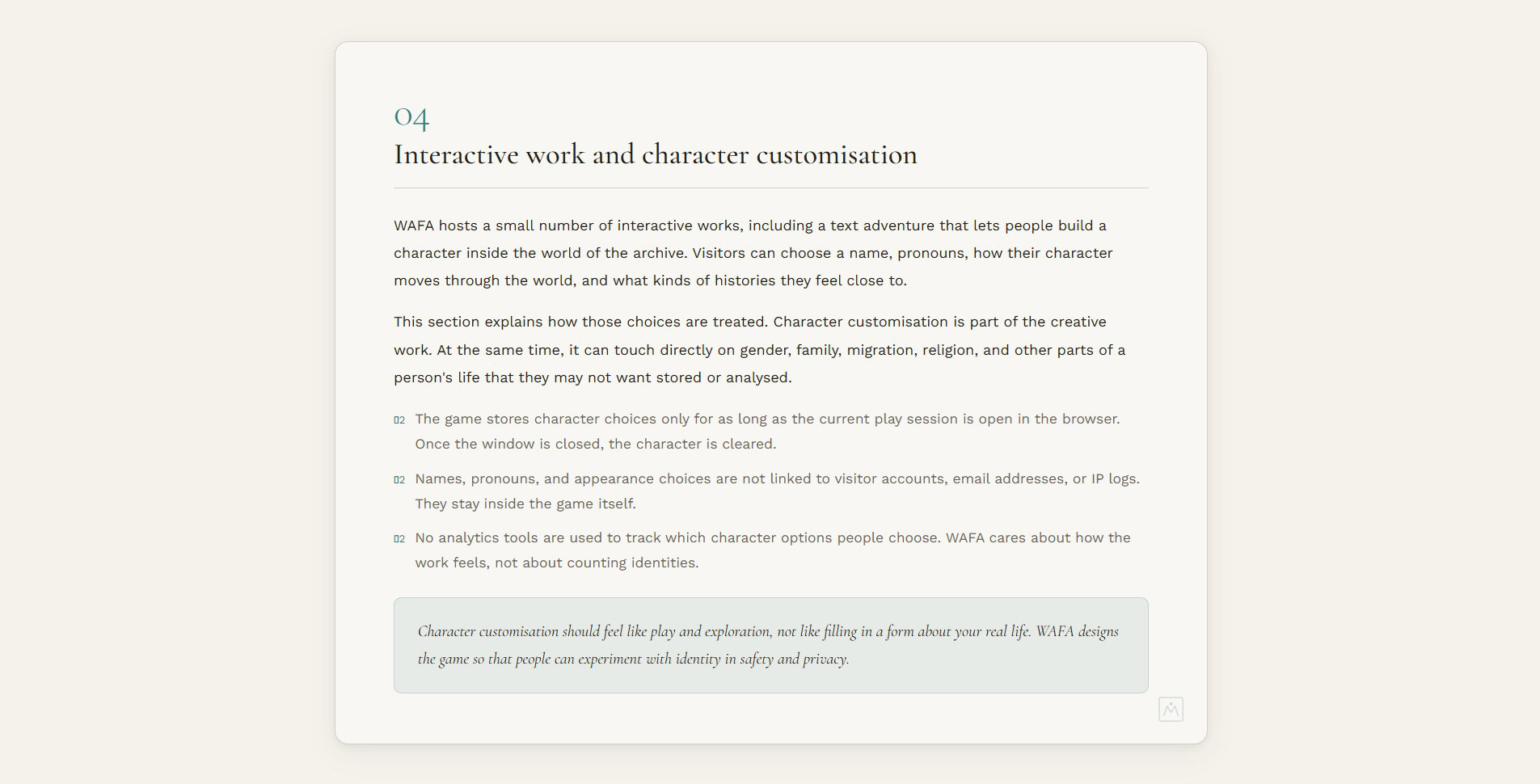
Interactive work and character customisation
WAFA hosts a small number of interactive works, including a text adventure that lets people build a character inside the world of the archive. Visitors can choose a name, pronouns, how their character moves through the world, and what kinds of histories they feel close to.
This policy explains how those choices are treated. Character customisation is part of the creative work, but it can also touch directly on gender, family, migration, religion, and other parts of a person’s life that they may not want stored or analysed.
WAFA’s commitments:
The game stores character choices only for as long as the current play session is open in the browser. Once the window is closed, the character is cleared.
Names, pronouns, and appearance choices are not linked to visitor accounts, email addresses, or IP logs; they stay inside the game itself.
No analytics tools are used to track which character options people choose. WAFA cares about how the work feels, not about counting identities.
Underlying principle:
Character customisation should feel like play and exploration, not like filling in a form about real life. WAFA designs the game so that people can experiment with identity in safety and privacy.
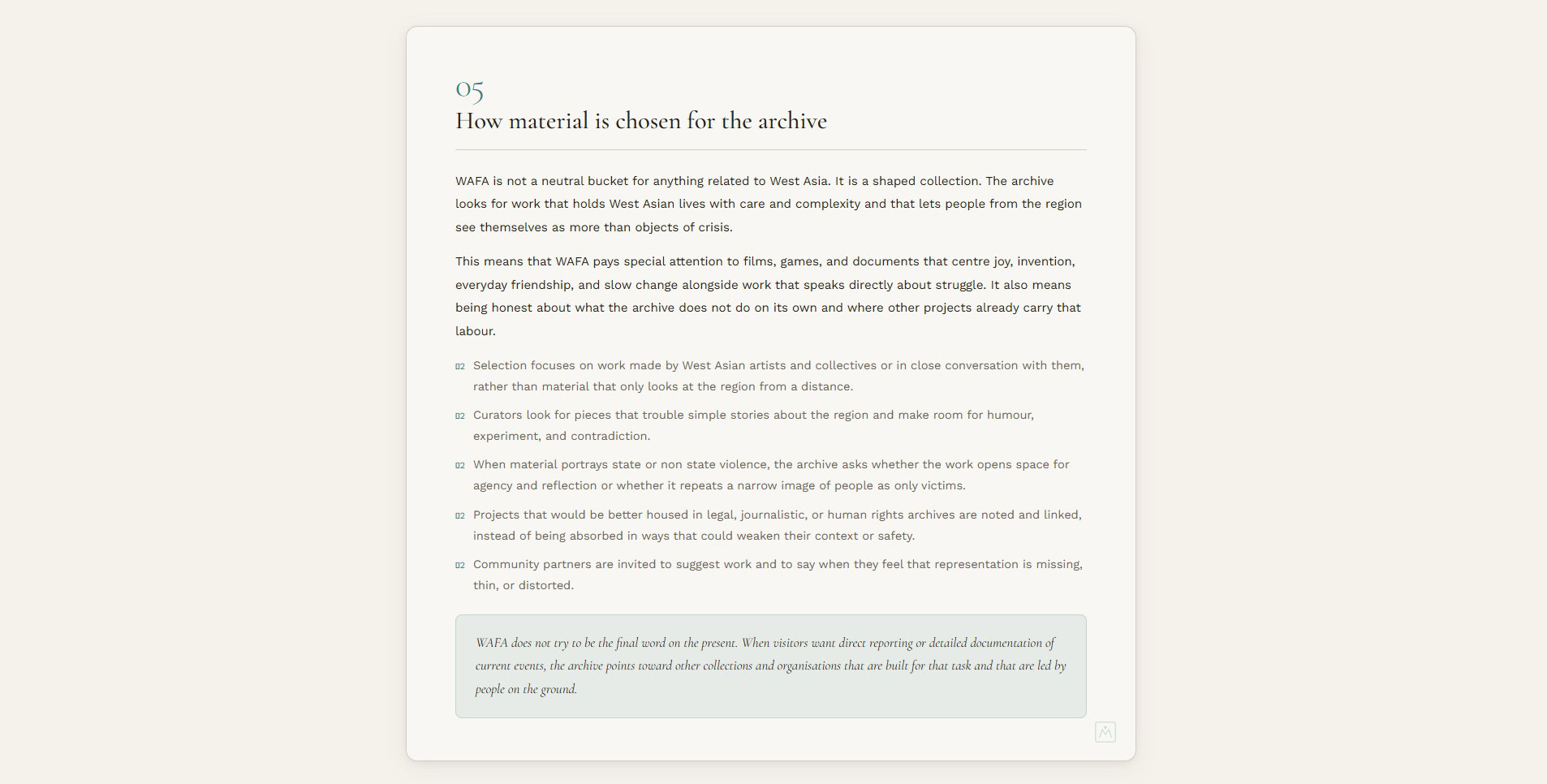
How material is chosen for the archive
WAFA is not a neutral bucket for anything related to West Asia; it is a shaped collection. The archive looks for work that holds West Asian lives with care and complexity and that lets people from the region see themselves as more than objects of crisis.
This means WAFA pays special attention to films, games, and documents that centre joy, invention, everyday friendship, and slow change, alongside work that speaks directly about struggle. It also means being honest about what the archive does not do on its own and where other projects already carry that labour.
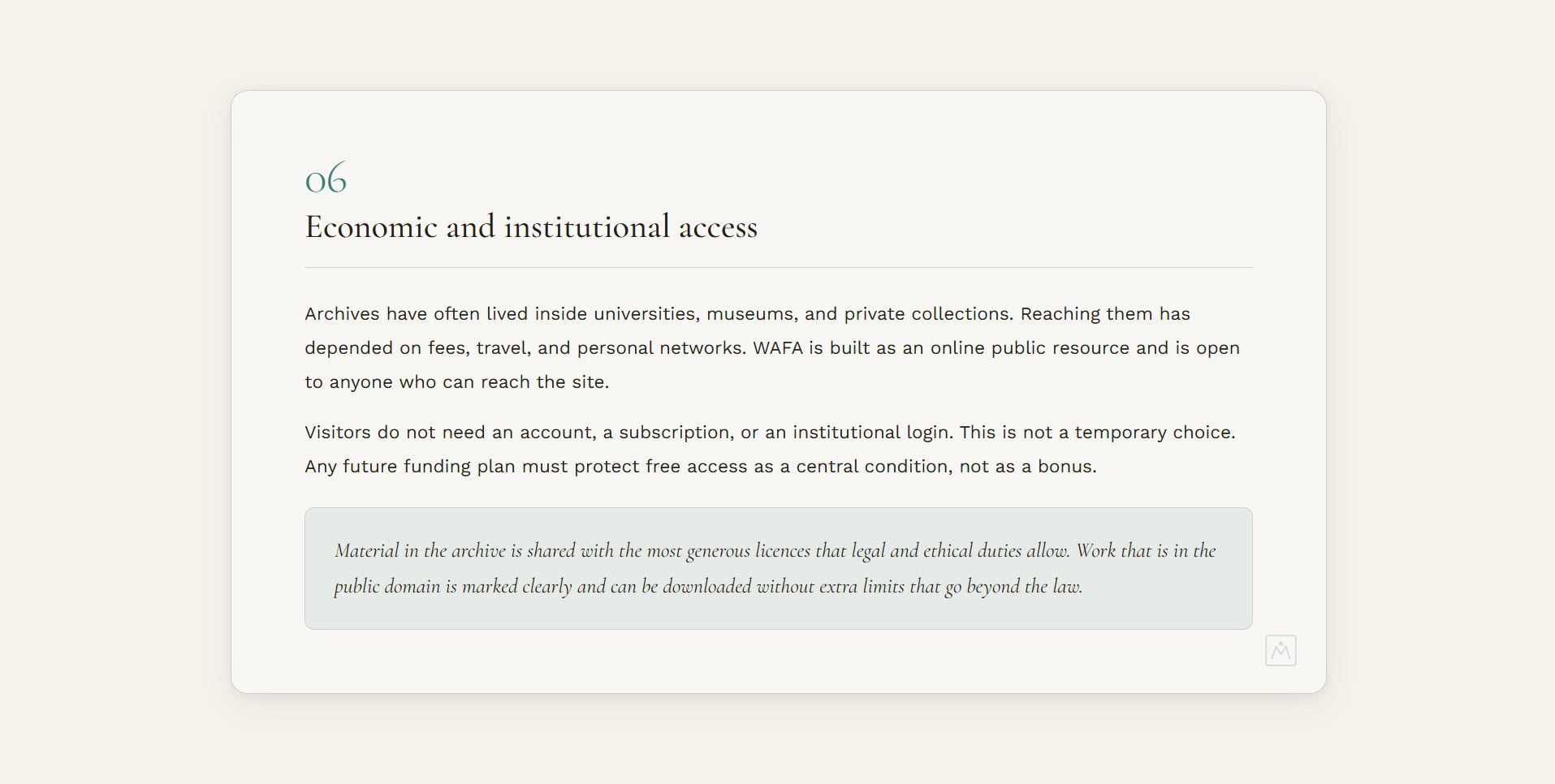
Economic and Institutional Accessibility
Access to archives has historically been gatekept by institutional affiliation, geographic proximity, and economic resources. You needed to be affiliated with an institution, near enough to travel, and free enough from paid work to spend time in a reading room during opening hours. WAFA operates online and is freely accessible to anyone with an internet connection. There are no fees, no registration requirements, no institutional log-in. This is a foundational commitment, not a temporary state pending the introduction of a subscription model.
The archive will remain free at the point of access. This is not a difficult decision in the abstract, but it has practical implications for how the project is funded and sustained, and WAFA is honest about the fact that free access requires resources that have to come from somewhere. Current development is supported through academic institutional frameworks. Future funding strategies are being developed with the explicit requirement that they do not compromise open access, and potential partnerships are evaluated against this criterion.
Materials within the archive are made available with the most permissive licensing that their legal and ethical conditions allow. Where materials are in the public domain, they are clearly labelled as such and can be freely downloaded and used. Where materials are held under copyright, WAFA seeks to make them accessible for research, educational, and personal use while respecting the rights of creators and rights holders. The archive does not place additional restrictions on top of existing legal frameworks, and it actively advocates for the preservation of user rights including the right to access materials for research and educational purposes within copyright law.
Feedback, Reporting, and Accountability
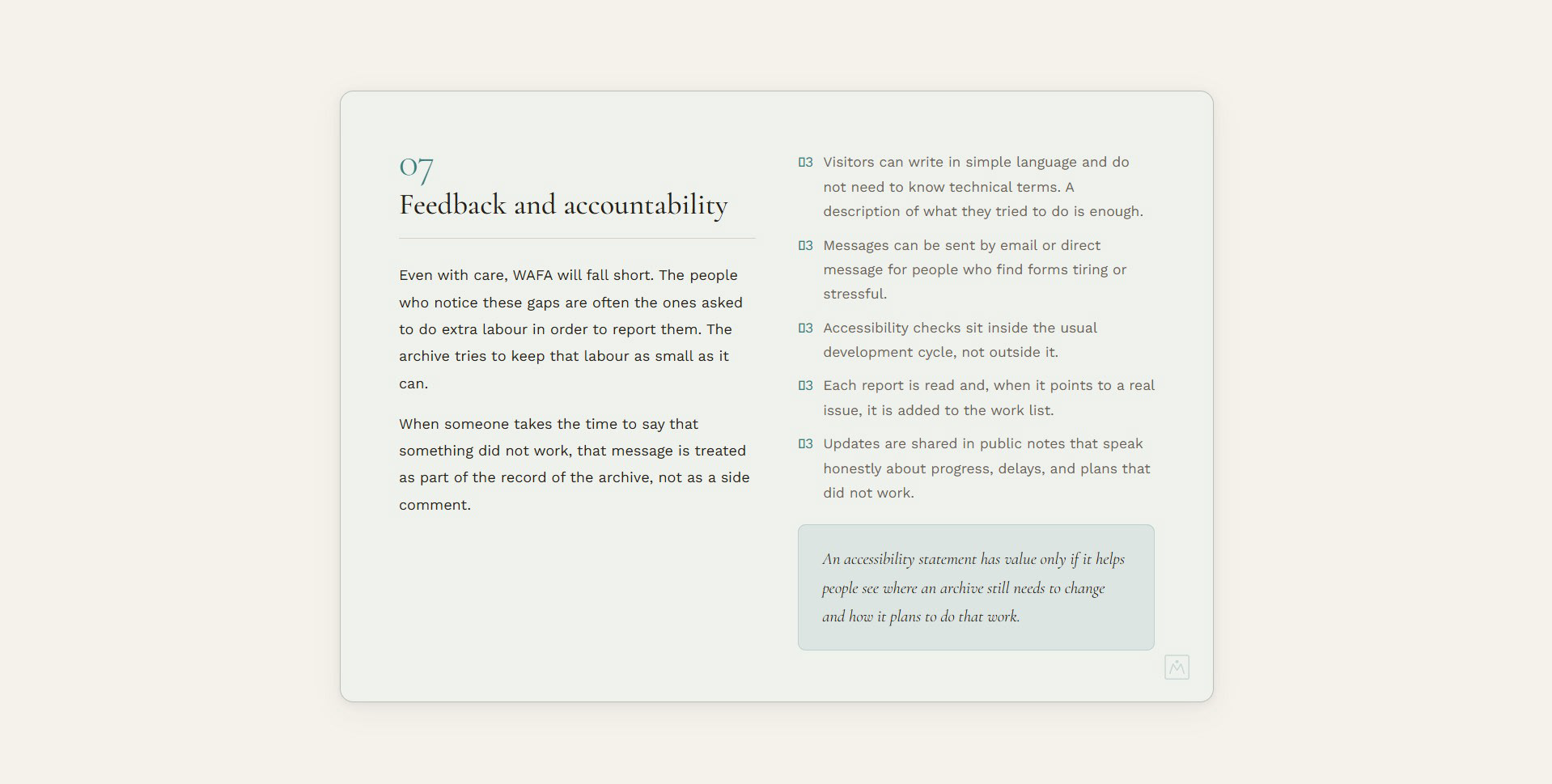
WAFA wants to know when it is not accessible, and it wants to know this in terms that are specific enough to act on.
General statements that something is difficult to use are noted and appreciated, but detailed feedback about which specific element of the archive created a barrier, what device or assistive technology was being used, and what the user was trying to do when the problem occurred allows us to address problems systematically rather than speculatively. The contact form on this site includes an option to submit accessibility feedback, and responses to accessibility reports are given priority within our response process.
We are also aware that asking users who have encountered a barrier to then spend additional time and effort reporting it is itself an accessibility issue one that falls disproportionately on the people the accessibility provisions are designed to serve. We work to identify and address barriers proactively rather than reactively, through regular testing and review, and we try to make the feedback process as low-effort as possible, including offering email and direct message options for users who find form interfaces difficult.
Accessibility is not a static achievement. The archive grows and changes, and each change is an opportunity to introduce new barriers as well as to remove existing ones. WAFA conducts accessibility reviews as a standard part of its development cycle, not as a separate periodic exercise, and accessibility considerations are built into the evaluation criteria for any new feature, interface change, or content addition.
Accessibility, in all the senses that WAFA understands it, is not a problem that gets solved and filed. It is a condition that requires sustained attention, regular re-evaluation, and genuine willingness to be told that something is not working.
The film cultures that WAFA engages with have not always been well served by the institutions that claimed to represent them. An archive that makes the same exclusions in digital form as physical archives have made in physical form is not a counter-archive in any meaningful sense it is the same set of barriers with a different interface.
WAFA takes this seriously, and it informs everything from the technical choices made in building the archive to the language used to describe its contents to the question of who is considered a potential user from the very beginning of the design process.
There will always be more to do. The gap between commitment and implementation is real, and this page does not pretend otherwise. What it offers instead is honesty about where the archive currently stands, clarity about where it is trying to go, and an open door for anyone who wants to help close the distance between the two.
Accessibility enquiries, reports, and feedback can be directed to the contact details below. Every report is read, and every substantive issue raised is added to the development record.
Thank you for taking the time to read this. And if you spotted something on your way here that we missed: please tell us.
Thank you!